Products / Recycled Pallets
Recycled & Refurbished Pallets
Damaged pallets get a second life. We replace broken boards with reclaimed lumber, secure every fastener, and deliver a pallet that performs like new — at a fraction of the environmental cost.
Request a Quote
Tell us what you need — we respond within 24 hours.
What Makes a Pallet “Recycled”?
A recycled pallet is a pallet that has been disassembled, repaired, or rebuilt using reclaimed lumber. Unlike a “used” pallet — which is simply resold in its existing condition — a recycled pallet has undergone active refurbishment.
The process typically involves replacing one or more broken, split, or missing deck boards with boards salvaged from other pallets. Stringers may be reinforced or replaced. Every nail is re-driven or swapped with a ring-shank fastener for added grip. The result is a structurally sound pallet that costs less than new and keeps usable wood out of the waste stream.
Recycled pallets are the cornerstone of the circular pallet economy. The wood fiber in a single pallet can be reused multiple times — first as a repaired pallet, then as reclaimed boards in other pallets, and eventually as mulch, animal bedding, or biomass energy. At Universal Pallet Supply, we ensure that every piece of usable wood stays in circulation as long as possible.
Recycled vs. Used — At a Glance
Recycled Pallet
Actively repaired with reclaimed lumber. One or more boards replaced. Higher labor investment, more uniform result.
Used Pallet
Resold as-is after grading. No board replacements. Lower cost, but condition varies more widely between units.
Our Recycling Process
From broken pallet to job-ready product in five disciplined steps.
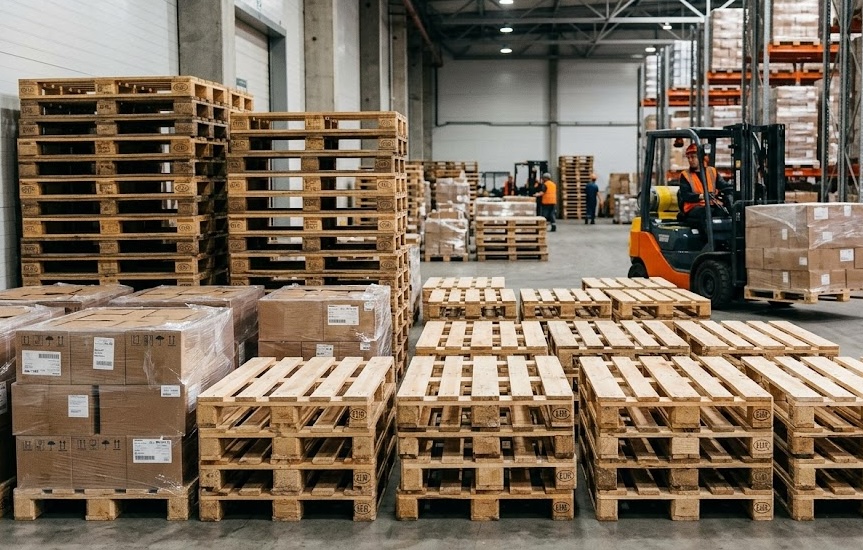
Collection & Sorting
We collect damaged, broken, and end-of-life pallets from warehouses, distribution centers, and manufacturers. Each incoming pallet is sorted by size, wood species, and condition to determine the most efficient repair path.
Dismantling
Pallets beyond repair are carefully dismantled. Usable boards are salvaged and sorted by thickness, width, and length. Nails are removed, and boards with irreparable splits or rot are diverted to mulch or biomass fuel.
Board Replacement & Repair
Damaged deck boards, lead boards, and stringers on repairable pallets are replaced with reclaimed lumber from our salvage inventory. Loose nails are re-driven or replaced with ring-shank nails for superior holding power.
Quality Inspection
Every recycled pallet undergoes the same structural inspection as our used pallets. We verify load capacity, board integrity, and overall dimensions. Pallets that do not meet our standards go back for further repair or are recycled into raw material.
Grading & Inventory
Finished pallets are graded, stacked, and added to our digital inventory system. Recycled pallets are clearly identified so you know exactly what you are getting — a fully restored pallet at a price between used and new.
Sustainability
The Environmental Case for Recycled Pallets
Every recycled pallet is a measurable win for the environment. Here is the data behind the impact.
3.5board-feet
of lumber saved per recycled pallet
Each pallet we recycle instead of replacing keeps nearly four board-feet of virgin lumber in the forest.
27lbs
of CO2 emissions avoided per pallet
Manufacturing a new pallet from raw timber generates significantly more carbon than repairing an existing one.
95%
of pallet wood is recoverable
Even pallets that cannot be reused as pallets can be processed into mulch, animal bedding, or biomass fuel.
700M+
pallets are in circulation in the US
Recycling keeps this massive pool of wood products in service, reducing pressure on timber resources.
Recycled vs. Used — Detailed Comparison
Both options save money and reduce waste. Here is how they differ across the factors that matter most.
| Feature | Recycled Pallet | Used Pallet |
|---|---|---|
| Source Material | Reclaimed lumber from dismantled pallets replaces damaged boards | Original boards from the initial manufacturing — no replacements |
| Repair Level | One or more boards replaced, nails re-driven, structurally restored | Minimal to no repair — cosmetic wear only, all original boards intact |
| Cost | Slightly higher than used due to labor, but lower than new | Lowest cost option for most standard sizes and grades |
| Consistency | More uniform appearance since damaged boards are swapped out | Varies by grade — Grade A is consistent, Grade C less so |
| Sustainability | Highest impact — extends pallet life and reuses salvaged lumber | High impact — reuses an existing product without additional processing |
| Best For | Companies wanting a balance of cost, appearance, and sustainability | Budget-conscious operations focused on lowest per-unit cost |
Your Sustainability Partner
Choosing recycled pallets is one of the simplest ways to reduce your company's environmental footprint. When you partner with Universal Pallet Supply, we provide documentation that quantifies the impact — lumber saved, emissions avoided, and waste diverted — so you can include it in your sustainability reporting.
We work with companies in food and beverage, retail, manufacturing, and logistics to build pallet programs that prioritize recycled and reclaimed products wherever possible. Whether you need 100 pallets a month or 10,000, our recycled inventory can scale with your business while keeping your environmental commitments on track.
Start Your Green Pallet ProgramMeasure Your Impact
Environmental Impact at Scale
Every recycled pallet you use instead of a new one contributes to measurable environmental savings. Here is what those numbers look like at different volumes — the kind of data you can include in your corporate sustainability reports.
Small Business
500
recycled pallets / year
12
mature trees preserved
13,500 lbs
CO2 emissions avoided
1,750 bd ft
virgin lumber saved
Mid-Size Operation
2,500
recycled pallets / year
60
mature trees preserved
67,500 lbs
CO2 emissions avoided
8,750 bd ft
virgin lumber saved
Large Distribution
10,000
recycled pallets / year
240
mature trees preserved
270,000 lbs
CO2 emissions avoided
35,000 bd ft
virgin lumber saved
Enterprise Scale
50,000
recycled pallets / year
1,200
mature trees preserved
1,350,000 lbs
CO2 emissions avoided
175,000 bd ft
virgin lumber saved
Calculations based on Virginia Department of Forestry and USDA Forest Products Laboratory data: approximately 3.5 board-feet of lumber saved per recycled pallet, 27 lbs of CO2 avoided per pallet vs. new construction, and roughly 1 mature tree per 42 pallets recycled. We provide documented impact reports for customers ordering 1,000+ recycled pallets annually.
Recycled vs. New Pallets — Full Comparison
The question is not whether recycled pallets work — it is whether your application specifically requires new construction. For the vast majority of domestic shipping and warehousing, recycled pallets deliver equivalent performance at a lower price and environmental cost.
| Factor | Recycled Pallet | New Pallet |
|---|---|---|
| Cost (48×40) | $6 – $9 per pallet | $9 – $15+ per pallet |
| Dynamic Load Capacity | Up to 2,500 lbs | Up to 2,800 lbs |
| Static Load Capacity | Up to 7,000 lbs | Up to 7,500 lbs |
| Appearance | Good — mixed board coloring with replaced boards | Excellent — uniform color and clean surfaces |
| Environmental Impact | Lowest carbon footprint of any pallet option | Highest carbon footprint due to virgin lumber and manufacturing |
| ISPM-15 Compliance | Not typically available (mixed lumber history) | Available with heat treatment and certified stamping |
| Consistency | Moderate — minor visual variations between units | High — identical dimensions, color, and finish |
| Service Life | 8–15 trips depending on grade and handling | 15–20 trips with standard handling practices |
Built to Perform
Quality Assurance for Every Recycled Pallet
Recycled does not mean lower standards. Our quality assurance process ensures that every recycled pallet meets the same structural benchmarks as our used and new inventory. Here is what happens before a recycled pallet is cleared for sale.
Board-Match Grading
Replacement boards are matched to the original pallet by species, thickness, and width. A recycled pallet with mixed hardwood and softwood boards will have inconsistent strength — we avoid this by maintaining sorted salvage inventory.
Fastener Upgrade
Every nail on a recycled pallet is either re-driven or replaced with ring-shank nails that provide 40% more withdrawal resistance. This is especially important for replaced boards, which need maximum holding power at the joint.
Load Test Sampling
We pull random samples from every production batch and subject them to static load testing. If any pallet in the sample fails below the rated capacity for its grade, the entire batch is reinspected and reworked.
Dimensional Verification
After board replacement and fastener work, overall dimensions are re-checked. Board replacement can slightly alter the footprint — we trim or adjust to keep every pallet within +/- 1/4 inch of standard dimensions.
Our Quality Guarantee
We stand behind every recycled pallet we sell. If a pallet fails to meet the structural specifications of its assigned grade during normal use, we will replace it at no cost. Our goal is simple: you should never be able to tell the difference between a recycled pallet and a new one based on performance alone.
Industry Applications
Where Recycled Pallets Excel
Recycled pallets are the smart choice for industries that prioritize cost efficiency, sustainability, and reliable performance. Here is how specific sectors use them.
Retail Distribution
Major retailers and distribution centers across the eastern US use our recycled pallets for store replenishment and warehouse inventory staging. Recycled pallets provide the clean, consistent appearance that retail buyers expect while delivering 30–40% savings compared to new. Ideal for domestic LTL and full-truckload shipments to stores, regional DCs, and e-commerce fulfillment centers.
Food & Beverage Manufacturing
Beverage distributors, bakeries, frozen food producers, and packaged food manufacturers rely on recycled pallets for domestic distribution routes. The replaced boards and secure fasteners provide a uniform surface that works well with automated stretch wrappers and pallet conveyors. Recycled pallets are the top choice for food companies that want to meet sustainability goals without switching to more expensive new pallet programs.
Third-Party Logistics (3PL)
3PL warehouses in Virginia, North Carolina, and the Mid-Atlantic region are among our largest recycled pallet customers. 3PLs serve dozens of clients with different pallet needs — recycled pallets provide a reliable middle ground between the lowest-cost used pallets and the premium pricing of new. The consistent quality reduces pallet-related damage claims across multiple client accounts.
Building Materials & Construction
Lumber yards, roofing suppliers, and construction material distributors use recycled pallets to ship heavy, bulky products like drywall, concrete bags, and bundled lumber. Grade B and C recycled pallets handle the weight and the rough treatment of construction sites at a fraction of the cost of new pallets that will likely be discarded after a single delivery.
Agriculture & Nursery
Farms, greenhouses, nurseries, and agricultural co-ops throughout Virginia and the Carolinas use recycled pallets for seasonal shipping of produce, plants, and animal feed. Recycled pallets are the perfect fit for agriculture’s cyclical demand patterns — affordable enough to use as one-way shipping platforms during peak harvest, and sustainable enough to align with the agricultural sector’s growing environmental commitments.
Manufacturing & Industrial
Factories, assembly plants, and industrial supply companies use recycled pallets for outbound shipments, interplant transfers, and work-in-progress storage. The structural integrity of our recycled pallets supports loads up to 2,500 lbs dynamic, making them suitable for everything from automotive parts to packaged chemicals. Many manufacturers include recycled pallets in their ISO 14001 environmental management programs.
Quality Standards
Our Recycling Standards
Not all recycled pallets are created equal. Our standards ensure that every recycled pallet we sell delivers consistent, reliable performance. Here is exactly what we require before a recycled pallet enters our inventory.
Board Species Matching
Replacement boards are matched to the original pallet by wood species. Mixing softwood and hardwood boards creates uneven strength distribution and inconsistent nail holding. We maintain sorted salvage inventory by species to ensure every repaired pallet has uniform structural properties across all boards.
Nail Quality Requirements
Every fastener on a recycled pallet must be a ring-shank or spiral-shank nail driven flush with the board surface. Smooth-shank nails are replaced. Protruding nails are re-driven or pulled and replaced. We use a minimum of three nails per board-to-stringer joint on all recycled pallets.
Dimensional Tolerance
Recycled pallets must fall within +/- 1/4 inch of standard dimensions for the specified size. Board replacement can shift overall dimensions, so we verify length, width, and height after every repair. Pallets outside tolerance are trimmed or rebuilt until they conform.
Moisture Content Limits
All replacement boards must have a moisture content below 19% before installation. Boards above this threshold are air-dried or kiln-dried before use. High-moisture boards warp, shrink, and loosen fasteners within weeks, undermining the entire repair.
Contamination Zero-Tolerance
Boards salvaged from pallets that carried chemicals, food waste, animal products, or any potentially hazardous material are excluded from our recycling stream. We visually inspect and smell-test every board before it enters our salvage inventory.
Load-Bearing Verification
We pull random samples from every recycled production batch and subject them to static load testing at 150% of the rated capacity. If any sample fails, the entire batch is reinspected. Our target is a 99.8% pass rate on first inspection across all recycled pallets.
How to Order
Ordering Made Simple
Getting recycled pallets delivered to your dock is straightforward. Follow these four steps and you will have pallets on-site within days.
Tell Us What You Need
Contact us with your pallet size, quantity, and delivery location. If you are not sure which size or grade works best, our team will recommend the right option based on your load weight and application.
Receive Your Quote
We respond with a detailed quote within 4 business hours. Your quote includes per-unit pricing, delivery cost, estimated availability, and a suggested delivery date. No hidden fees or surprise charges.
Approve & Schedule
Approve your quote via email or phone. We lock in your pricing, reserve inventory from our yard, and schedule a delivery window that works for your receiving dock. Most orders ship within 1–3 business days.
Delivery & Inspection
Your recycled pallets arrive on our truck or via a trusted carrier. Every load includes a delivery ticket with the exact count, grade, and size. Inspect on receipt — if anything does not match your order, we correct it within 24 hours.
Most orders are quoted within hours and delivered within 1–3 business days.
Ready to Switch to Recycled Pallets?
Let us know your size, volume, and delivery schedule. We will build a recycled pallet program that fits your budget and your sustainability goals.