Our Process
From Collection to Delivery: Every Step Matters
Our seven-step process ensures that every pallet we handle is inspected, graded, repaired if needed, quality-checked, and delivered to the highest standard. No shortcuts. No waste.
Get in Touch
Request a quote or ask us anything.
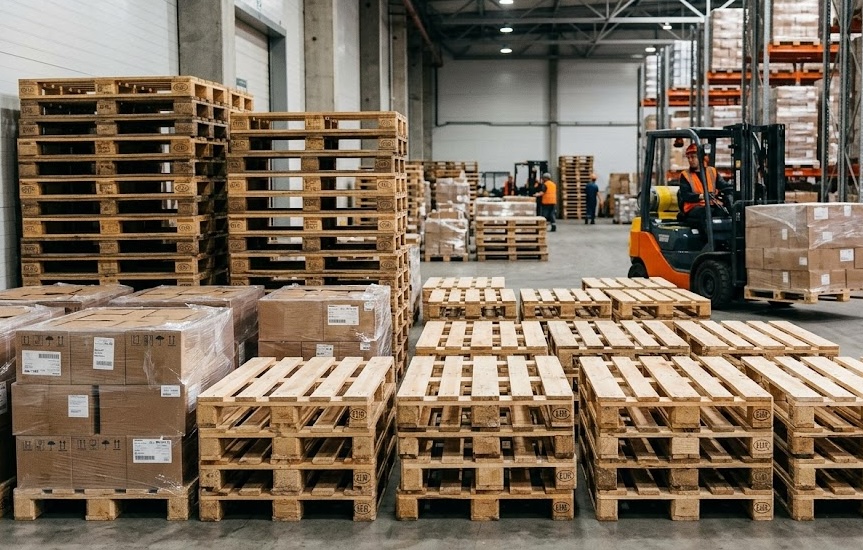
The 7-Step Journey of a Recycled Pallet
Every pallet that enters our facility follows a proven, systematic process designed to maximize quality, minimize waste, and deliver consistent results.
Collection
Inspection
Sorting & Grading
Repair
Quality Check
Storage
Delivery
Collection
Gathering pallets from across the supply chain
Our process begins at the source. We maintain collection partnerships with warehouses, distribution centers, manufacturing plants, retail locations, and logistics providers across the country. Our fleet of flatbed trucks runs scheduled routes to pick up surplus, used, and unwanted pallets — often at no cost to the supplier.
Industry Insight
Many businesses pay waste haulers $3–$5 per pallet for disposal. Our collection service eliminates that cost — and in many cases, we pay for the pallets. It turns a line-item expense into revenue.
What Happens at This Stage
Scheduled pickups on weekly, bi-weekly, or on-demand basis
Full-truckload and partial-load collection options
Free removal for large-volume generators (50+ pallets)
Pallet buyback program — we pay for pallets in good condition
GPS-tracked fleet for reliable pickup windows
Inspection
Evaluating every pallet that enters our facility
When pallets arrive at our facility, every single one undergoes a visual and structural inspection. Trained inspectors assess the overall condition, check for damage, contamination, pest infestation, and any signs of chemical exposure. This initial inspection determines the pallet's path through our system.
Industry Insight
Our rejection rate at initial inspection is approximately 2–3%. These pallets are typically contaminated with hazardous materials and cannot safely enter the recycling stream. Everything else — from pristine Grade A pallets to heavily damaged units — has a place in our zero-waste system.
What Happens at This Stage
Visual inspection for cracks, splits, and missing components
Structural integrity testing — weight-bearing capacity verification
Contamination screening for chemicals, food residue, and mold
Pest inspection in compliance with ISPM-15 standards
Moisture content measurement using calibrated meters
Sorting & Grading
Classifying pallets by condition and specification
After inspection, pallets are sorted into categories based on their current condition, size, type, and the best use pathway. Our grading system follows industry standards and provides buyers with clear, consistent quality expectations. Sorting also groups pallets by size and specification for efficient storage and order fulfillment.
Industry Insight
Approximately 60% of pallets we receive grade as A or B — ready for immediate resale with no repair needed. Another 25% grade as C and enter our repair line. The remaining 15% are dismantled for parts, and the recovered lumber feeds back into our repair operation.
What Happens at This Stage
Grade A — Like-new condition: no visible damage, all boards intact, structurally sound for heavy loads
Grade B — Good condition: minor cosmetic wear, fully functional, suitable for most standard shipping applications
Grade C — Repairable condition: one or more components need replacement or reinforcement before reuse
End-of-life — Pallets destined for dismantling and lumber reclamation
Specialty sorting for non-standard sizes, heat-treated pallets, and custom specifications
Repair
Restoring pallets to full working condition
Grade C pallets move to our repair line, where skilled technicians replace damaged boards, reinforce weakened stringers, remove protruding nails, and restore each pallet to a condition that meets or exceeds industry standards. We use reclaimed lumber from dismantled pallets whenever possible, minimizing the need for new wood.
Industry Insight
Our repair technicians process an average of 80–120 pallets per day each. With a team of trained specialists, we maintain a repair throughput of thousands of pallets per week. Quality is never sacrificed for speed — every repaired pallet must pass the same structural standards as a Grade A unit.
What Happens at This Stage
Board replacement using color-matched reclaimed lumber
Stringer repair and reinforcement with industrial-grade fasteners
Nail extraction and pneumatic re-nailing for secure assembly
Lead board alignment to ensure compatibility with automated handling systems
Custom modifications available — notched stringers, reinforced decks, ISPM-15 heat treatment
Quality Check
Final verification before any pallet leaves our facility
Before a pallet is cleared for sale or delivery, it passes through a final quality check. This is a separate inspection from the initial assessment — performed by a different team member to provide an independent evaluation. We check structural integrity, dimensional accuracy, and compliance with any customer-specific requirements.
Industry Insight
Our quality rejection rate at this stage is under 1%. Pallets that do not pass are returned to repair for correction. This two-stage inspection system ensures that the pallets our customers receive are consistently reliable, safe, and ready for service.
What Happens at This Stage
Independent inspector — never the same person who performed the repair
Weight load testing on random samples from each batch
Dimensional verification: length, width, and height within tolerance
Fastener security check — no loose nails, no protruding hardware
ISPM-15 stamp verification for heat-treated pallets
Storage
Organized inventory ready for rapid fulfillment
Approved pallets are moved to our organized storage yard, sorted by grade, size, and type. Our inventory management system tracks every pallet from arrival to dispatch, allowing us to fulfill orders quickly and accurately. Covered storage areas protect pallets from weather, and our layout is optimized for efficient loading.
Industry Insight
We maintain a rolling inventory of 50,000+ pallets across our facilities at any given time. This buffer ensures that we can fulfill most orders within 24–48 hours, even for large volumes. Seasonal demand — particularly in Q4 when shipping volumes surge — is anticipated and pre-stocked.
What Happens at This Stage
Climate-appropriate storage — covered bays for weather protection
Inventory organized by grade (A, B, C), size, and type
Real-time inventory tracking for accurate availability information
Large buffer stock to handle seasonal demand spikes
Dedicated staging areas for custom and pre-ordered pallets
Delivery
Reliable transportation on your schedule
The final step in our process is getting pallets to our customers safely and on time. Our company-owned fleet handles deliveries across our primary service areas, and we partner with trusted carriers for nationwide reach. We offer flexible scheduling, from next-day delivery to recurring standing orders.
Industry Insight
Our on-time delivery rate consistently exceeds 97%. For recurring customers, we establish standing delivery schedules that integrate seamlessly with their receiving operations. This reliability is not an accident — it is the result of careful route planning, fleet maintenance, and a team that takes every commitment seriously.
What Happens at This Stage
Company-owned flatbed fleet for regional deliveries
Nationwide shipping through vetted carrier partnerships
Full truckload (FTL) and less-than-truckload (LTL) options
Scheduled recurring deliveries for consistent-volume customers
Real-time delivery tracking and proactive communication
The Circular Economy Approach
Our process is not linear — it is circular. Pallets loop through our system multiple times, and nothing leaves as waste.
Closed-Loop Reuse
Pallets in good condition are cleaned, re-graded, and returned to the supply chain — often within 48 hours of arrival at our facility. This rapid turnaround keeps pallets productive and out of waste streams.
Material Recovery
Damaged pallets are dismantled and their usable components recovered. Boards become repair stock. Stringers become raw material. The salvage rate from dismantled pallets averages 65–75%.
Byproduct Utilization
Wood that cannot be reused structurally is ground into mulch, composted, or converted to biomass fuel. Metal fasteners are separated and sent to scrap recyclers. Our landfill diversion rate is 100%.
Why Our Process Matters to You
When you buy a recycled pallet from Universal Pallet Supply, you are not getting a random pallet pulled from a pile. You are getting a product that has been through a seven-step quality process, inspected by trained professionals, and cleared by an independent quality check before it ever reaches your dock.
This level of rigor is what separates professional pallet recyclers from informal operations. It is the reason our customers can load our Grade A recycled pallets into automated racking systems and our Grade B pallets onto shipping floors without a second thought. They know what they are getting, because we have verified it at every step.
For businesses that depend on pallets — and that is nearly every business that ships physical goods — reliability is not optional. A failed pallet in a warehouse can damage product, injure workers, and disrupt operations. Our process exists to make sure that never happens.
Our Process by the Numbers
97%+
On-Time Delivery Rate
<1%
Final Quality Rejection Rate
24–48hr
Typical Order Fulfillment
50,000+
Pallets in Rolling Inventory
Quality Assurance
Detailed Quality Control Standards
Quality control at Universal Pallet Supply goes far beyond a quick visual glance. Every pallet that passes through our facility is evaluated against a rigorous set of criteria developed over fifteen years of hands-on experience in the recycled pallet industry. Our inspection process is designed to catch defects that could compromise structural integrity, worker safety, or product protection during shipping.
Our inspectors check for cracked or split deck boards, broken or notched stringers, missing lead boards, protruding or loose nails, evidence of mold or fungal growth, chemical staining or contamination, and excessive moisture content. Pallets with moisture readings above 25% are set aside for air drying before they re-enter the grading process, as high moisture content can promote mold growth and weaken wood fibers over time.
For customers with specific requirements — such as food-grade facilities, pharmaceutical distribution, or automated warehouse systems — we apply additional criteria. This can include tighter dimensional tolerances (plus or minus one-eighth of an inch), zero-defect lead board alignment for compatibility with automated guided vehicles, or heat treatment certification with proper ISPM-15 stamping for export compliance.
Structural Load Testing
Random samples from each batch are load-tested to verify they can safely support their rated weight capacity — typically 2,500 lbs for standard GMA pallets in racking and 2,800 lbs on the floor.
Dimensional Accuracy
Length, width, and deck board spacing are verified with calibrated measuring tools. Pallets outside of tolerance are flagged for repair or reclassification.
Fastener Integrity
All nails and staples are checked for tightness and proper seating. Protruding fasteners are a safety hazard and an automatic fail — the pallet is pulled and refastened before clearance.
Contamination Screening
Visual and olfactory inspection for chemical residue, food waste, oil stains, and biological contamination. Contaminated pallets are quarantined and assessed for safe processing.
Moisture Content
Calibrated pin-type moisture meters verify that wood moisture content is below 25% to prevent mold growth and ensure structural integrity during storage and transit.
Our Equipment
Tools of the Trade
Professional pallet recycling requires professional equipment. Our Portsmouth facility is outfitted with the tools and machinery needed to process thousands of pallets per day safely, efficiently, and to the highest quality standards.
Pneumatic Nail Guns
Industrial-grade coil nailers and palm nailers drive ring-shank nails into pallet lumber with consistent depth and holding power. Our technicians use these tools for board replacement, stringer reinforcement, and new pallet assembly. Ring-shank nails provide 40% more holding power than smooth-shank alternatives.
Band Saws & Cut-Off Saws
Precision band saws cut reclaimed lumber to exact dimensions for board replacement. Cut-off saws trim stringers and deck boards to specification. All cuts are measured against templates to ensure dimensional consistency across every repaired pallet in a batch.
Heat Treatment Kilns
Our on-site heat treatment chamber raises the core temperature of wood to 56 degrees Celsius (133 degrees Fahrenheit) for a minimum of 30 minutes, meeting ISPM-15 international phytosanitary standards. Temperature is monitored with embedded probes and logged for compliance documentation.
Forklifts & Material Handlers
A fleet of propane and electric forklifts moves pallets through every stage of our process — from inbound unloading to sorting, staging, and outbound loading. Our operators are OSHA-certified and trained in safe load handling for stacked pallet configurations up to 12 feet high.
Environmental Impact
The Environmental Cost of Our Process vs. Manufacturing New
Every pallet we recycle avoids the environmental burden of manufacturing a new one. Here is a detailed breakdown of the resources saved per pallet through our process.
10-20 kg
per pallet
CO2 Emissions Saved
A new pallet generates 20-30 kg of CO2 from forestry, milling, kiln drying, assembly, and transport. Our recycling process produces only 5-10 kg — primarily from collection and minor repair. That is a 50-65% reduction in carbon emissions per unit.
3.5 bd ft
per pallet
Lumber Preserved
Every recycled standard 48x40 pallet avoids the consumption of approximately 3.5 board feet of new lumber. Over 2 million pallets per year, that adds up to 7 million board feet of timber left standing in forests.
75%
reduction vs. new
Water Saved
New pallet manufacturing requires water for tree growth, mill processing, and kiln operations. Our recycling process uses water only for facility cleaning and minor equipment cooling — a reduction of approximately 75% per pallet.
60%
reduction vs. new
Energy Saved
Logging, sawmilling, and kiln drying are energy-intensive operations. Pallet recycling skips all of those steps, reducing energy consumption by roughly 60% per unit. Our facility is also investing in rooftop solar to further reduce grid energy dependence.
12,000+
tons per year
Landfill Space Saved
Our zero-waste operation diverts over 12,000 tons of wood from landfills annually. That is equivalent to roughly 600 full garbage truck loads — space preserved for materials that genuinely cannot be recycled or repurposed.
100%
diversion rate
Methane Prevention
Wood decomposing in landfills produces methane, a greenhouse gas 80x more potent than CO2 over 20 years. By keeping 100% of our wood out of landfills, we prevent the methane emissions that would result from anaerobic decomposition.
A Pallet's Journey
From Arrival to Departure
Follow a single pallet through every touchpoint in our facility. This detailed walkthrough shows exactly what happens from the moment a truck pulls in to the moment a finished pallet ships out.
Gate Check-In
Every inbound truck is logged at the gate with driver credentials, source location, and estimated pallet count. Load documentation is verified before the truck proceeds to the unloading bay.
Unloading & Count
Forklifts unload pallets onto the receiving pad. A physical count is performed against the manifest. Any discrepancies are flagged and resolved with the supplier immediately.
Initial Triage
Inspectors perform rapid visual screening to separate pallets into three streams: ready for resale (Grade A/B), needs repair (Grade C), and needs dismantling (end-of-life).
Deep Inspection
Grade A and B pallets undergo structural testing, moisture measurement, and contamination checks. Each pallet receives a grade tag before moving to the storage yard.
Repair Station
Grade C pallets move to repair bays where technicians replace broken boards, reinforce stringers, and re-nail using reclaimed lumber. Each repair is logged in our tracking system.
Post-Repair QC
A separate quality inspector — never the same person who performed the repair — verifies dimensional accuracy, fastener security, and load capacity before clearing the pallet.
Staging & Inventory
Approved pallets are moved to the staging yard, organized by grade, size, and customer allocation. Inventory is updated in real time so orders can be picked and loaded on demand.
Loading & Dispatch
Outbound orders are pulled from staging, loaded onto flatbeds with documented pallet counts, and dispatched with delivery confirmation tracking active from departure to arrival.
Innovation
Technology in Our Process
Pallet recycling might seem like a low-tech business, but modern technology plays a critical role in our ability to process millions of pallets per year with consistent quality. From scanning and grading to inventory management, technology amplifies the skill of our workforce.
Our inventory management system tracks every pallet from arrival to dispatch using barcode scanning at each processing stage. This gives us real-time visibility into stock levels by grade, size, and type — allowing us to fulfill orders within hours, not days. Clients with recurring orders benefit from automated reorder triggers that ensure their supply never drops below threshold.
We are also piloting computer vision grading systems that use high-resolution cameras and machine learning algorithms to identify structural defects — cracks, splits, missing boards, and compromised stringers — in a fraction of the time required for manual inspection. Early results show a 40% reduction in grading time with equal or better defect detection accuracy.
Barcode Scanning & Tracking
Every pallet is tagged and scanned at each processing stage, creating a complete digital chain of custody from inbound receipt to outbound delivery.
AI-Assisted Grading (Pilot)
Computer vision cameras analyze pallet surfaces for defects, feeding data to machine learning models that classify condition with 95%+ accuracy.
Real-Time Inventory Dashboard
Our operations team monitors stock levels, processing throughput, and order fulfillment status through a live dashboard updated continuously throughout the day.
GPS Fleet Tracking
Every delivery truck is GPS-equipped, allowing us to provide clients with accurate ETAs and optimize route planning to reduce fuel consumption and emissions.
Moisture Monitoring Sensors
Calibrated digital moisture meters verify wood content at inspection, ensuring pallets meet the sub-25% threshold required to prevent mold and maintain structural integrity.
See Our Process in Action
Want to visit our facility, schedule a pickup, or get a quote on quality recycled pallets? We would love to hear from you.