How It Works
From Your Request to a Partner Supplier
We pass your request to partner suppliers, who quote and fulfill the work. Here is how that flows, plus what suppliers typically do with pallets along the way.
Get in Touch
Request a quote or ask a question using the form.
The 7 Steps From Request to Reuse
The first three steps cover your request. The rest describe what suppliers and recyclers typically do. We do not carry out those steps ourselves, and details vary by supplier.
Your Request
Referral
Quote
Sorting & Grading
Repair
Delivery or Pickup
Reuse
Your Request
Telling us what you need
Everything starts with the quote form. Tell us whether you want to buy, sell, or recycle pallets, along with the type, grade, quantity, and your location. Sending a request is free and carries no obligation.
Worth Knowing
If you are unsure about the grade, describe the load instead: what it weighs, how it is moved, and how it is stored. That gives a supplier something to work with.
What Happens at This Stage
Say whether you need to buy, sell, recycle, repair, or move pallets
Give the pallet type, size, and grade, if you know them
Include your quantity and location
Mention extras such as heat treatment or custom dimensions
Add anything a supplier should know in the message box
Referral
Passing your request to partner suppliers
We pass your request to partner suppliers in our network. We take requests from across the United States, and availability depends on partner suppliers. We do not hold stock or set prices, so we do not quote you ourselves.
Worth Knowing
Pallets are bulky, so distance matters. Supplier options and pricing can look very different from one area to another, which is why your location is one of the most useful details on the form.
What Happens at This Stage
Your request goes to partner suppliers in our network
Your contact details go with it so a supplier can reach you
Location and product type shape who can help
We do not hold inventory or set prices
Our role ends with the referral; the rest is between you and the supplier
Quote
A partner supplier follows up
A partner supplier follows up to confirm the details and provide a quote. This is the time to ask questions. Pricing, availability, and timing all come from the supplier, and you are free to say no.
Worth Knowing
When comparing quotes, compare the same things: grade definition, delivery, quantity, and what happens with rejected pallets. A lower price for a different grade is not the same offer.
What Happens at This Stage
The supplier confirms size, grade, quantity, and location
Pricing is set by the supplier, by quote
Ask what the quote includes, especially delivery
Ask how the supplier defines each grade
Ask for documentation if your load or destination requires it
Sorting & Grading
What suppliers typically do with used pallets
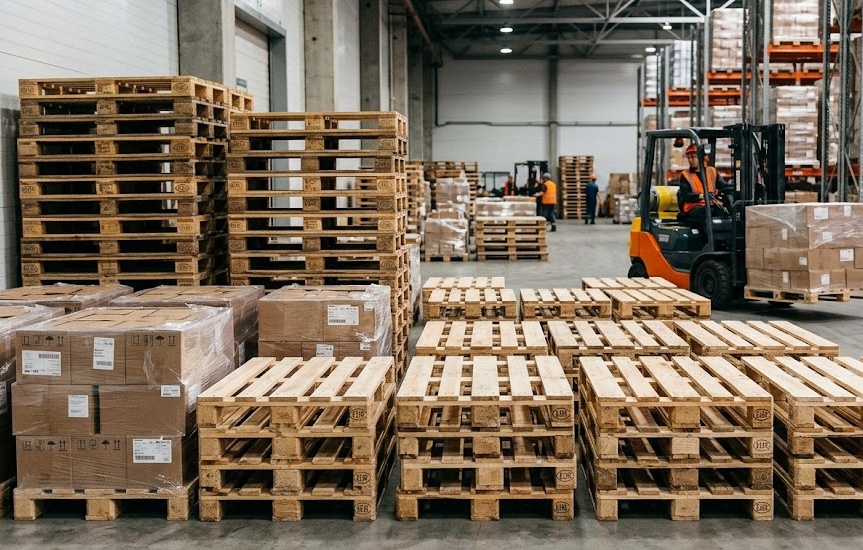
Used pallets come to recyclers from warehouses, distribution centers, and manufacturers. Recyclers typically look each pallet over, sort by size and condition, and set aside pallets that need repair or are past saving. Exact methods vary by supplier.
Worth Knowing
Grades are shorthand, not a formal national standard. One supplier's Grade A can differ from another's, so ask for a definition and, for a large order, consider asking for photos or a sample.
What Happens at This Stage
Grade A: usually little visible wear, with few or no repairs
Grade B: usually sound, with more wear and often some repairs
Grade C: usually heavier wear or repairs, for less demanding uses
End of life: pallets set aside for dismantling and wood recovery
Separate sorting for non-standard sizes and heat-treated pallets
Repair
Returning damaged pallets to service
Repairable pallets typically go to a repair station, where workers replace damaged boards, reinforce weak spots, and deal with protruding nails. Many recyclers use boards reclaimed from dismantled pallets, which keeps usable wood in service.
Worth Knowing
A repaired pallet can look different from an unrepaired one, with mixed board colors or extra hardware. If your line or racking is sensitive to that, say so in your request.
What Happens at This Stage
Broken deck boards are removed and replaced
Damaged stringers may be repaired or reinforced
Loose or protruding nails are fixed
Replacement boards are often reclaimed lumber
Some suppliers offer custom changes, such as notched stringers
Delivery or Pickup
Arranged directly with the supplier
Once you accept a quote, you arrange the details directly with the supplier. Some suppliers run their own trucks, others use carriers, and some offer customer pickup. Options, minimums, and timing depend on the supplier, your location, and the load.
Worth Knowing
Tell the supplier about your site before the truck is booked. Dock height, gate clearance, and unloading equipment can all affect what kind of delivery is practical.
What Happens at This Stage
Confirm whether delivery is included in the quote
Ask about load minimums and truck access at your site
Check whether you need a dock or a forklift to unload
Agree on how pallets will be counted at delivery
If you are selling, ask how pickup works and who loads
Reuse
What happens after a pallet is used
A used pallet does not have to be the end of the story. It can go back to a recycler to be sorted, repaired, and sold again. When it can no longer be repaired, recyclers commonly dismantle it for usable boards and grind the remaining wood.
Worth Knowing
What a recycler can take depends on the pallets. Wood that has been exposed to chemicals or heavily contaminated may need different handling, so mention any known issues in your request.
What Happens at This Stage
Surplus pallets can be offered to partner suppliers
Repairable pallets can go back into service
Usable boards can become repair stock
Leftover wood is commonly ground for mulch or biomass fuel
Ask a recycler what happens to the pallets it takes
How Pallet Reuse Works
Pallets do not have to follow a straight line from new to discarded. Here is how suppliers and recyclers keep them useful.
Direct Reuse
Pallets in good condition can be sorted, graded, and sold again with little or no repair. Reusing a pallet avoids building a new one.
Material Recovery
Damaged pallets are commonly dismantled so usable components can be recovered. Sound boards can become repair stock for other pallets.
Byproduct Utilization
Wood that cannot be reused is commonly ground for mulch or biomass fuel, and metal fasteners can go to scrap recyclers. Practices vary, so ask a recycler where material goes.
Why This Matters to You
Because a partner supplier fulfills your order, the quality of what reaches your dock depends on that supplier. Knowing how pallets are typically sorted and repaired helps you ask better questions before you commit.
Practices differ. Some recyclers sort more strictly than others, and what counts as acceptable for a warehouse floor may not suit automated racking. Ask how pallets are checked, what happens if some are rejected, and whether you can see a sample.
For businesses that ship physical goods, this matters. A failed pallet in a warehouse can damage product, injure workers, and disrupt operations. Make sure the pallets you accept suit your load and your equipment, and check them when they arrive.
The Service at a Glance
1
Form to Fill Out
Free
To Send a Quote Request
U.S.
Requests From Across the Country
You
Decide Whether to Go Ahead
Used Pallet Basics
What Suppliers Typically Check
We do not inspect pallets. Partner suppliers and recyclers do, and each one sets its own process. In general, a used pallet is checked for damage that could affect structural integrity, worker safety, or product protection during shipping.
Common things to look for include cracked or split deck boards, broken stringers, missing lead boards, protruding or loose nails, signs of mold, chemical staining, and excess moisture. Damp wood can encourage mold, so ask how pallets are stored as well.
If you have specific requirements, such as automated handling equipment or export rules, put them in your request and confirm them with the supplier. For sanitation-sensitive goods, check your own requirements and ask the supplier what they can document.
Structure
Are the deck boards, stringers, or blocks intact? Load capacity depends on the pallet and how it is supported, so describe your load and ask the supplier what suits it.
Dimensions
Is the pallet the size you asked for, with consistent board spacing? Size matters most in racking and on automated lines.
Fasteners
Are nails seated properly? Protruding fasteners are a safety hazard and can damage goods.
Contamination
Are there chemical stains, spills, odors, or food residue? Ask how the supplier screens for these.
Moisture
Does the wood seem wet or show signs of mold? Ask how pallets are stored before delivery.
Inside the Industry
Tools of the Trade
We do not own any of this equipment, but it helps to know what pallet recyclers and builders commonly use. Setups vary from one supplier to another.
Pneumatic Nail Guns
Coil nailers are a common tool for replacing boards, reinforcing stringers, and assembling new pallets. Ring-shank nails are widely used because their ridges help them grip the wood.
Band Saws & Cut-Off Saws
Band saws are often used to cut through nails and separate pallets for dismantling. Cut-off saws trim boards and stringers to length for repairs and new builds.
Heat Treatment Kilns
Heat treatment chambers bring wood to the ISPM 15 requirement of a 56°C core temperature for at least 30 minutes. If you need treated pallets, look for the IPPC mark and ask the supplier for documentation.
Forklifts & Material Handlers
Forklifts move stacks of pallets through recycling yards, from unloading to sorting, staging, and loading. If you receive pallets, think about what equipment you have for unloading before delivery day.
Reuse Versus New
What Reuse Avoids Compared With Building New
Reuse is not free of impact, since collection, repair, and transport all use resources. But a reused pallet avoids the steps needed to build a new one. Actual effects vary by pallet and distance.
New Lumber
Building a new wooden pallet takes new lumber. Reusing or repairing one avoids some or all of that demand, and repair with reclaimed boards reuses wood that has already been cut.
Milling and Drying
New lumber goes through sawmilling and often kiln drying before it becomes a pallet. A reused pallet skips those steps for the wood it keeps in service.
New Assembly
Pallets in good condition may need nothing more than sorting. Damaged ones need only their broken parts replaced rather than a full new build.
Disposal
A pallet that goes back into service or to a recycler does not need to be thrown away. Ask a recycler what it does with wood it cannot reuse.
Transport
Distance affects both cost and impact. Sourcing from a supplier closer to you can reduce the miles a load travels, which is one more reason to include your location.
What to Ask
Be cautious of absolute environmental claims from anyone. If this matters to your business, ask suppliers for specifics about what they reuse, recycle, and dispose of.
A Pallet's Journey
From Arrival to Departure
Curious what happens at a pallet recycler? This is a general walkthrough of a typical yard, from the moment a truck pulls in to the moment finished pallets ship out. Each supplier does it a little differently.
Gate Check-In
An inbound truck typically checks in with paperwork showing where the load came from and roughly how many pallets it holds.
Unloading & Count
Forklifts unload the pallets, and the yard counts them against the paperwork. Any difference gets sorted out with the source.
Initial Triage
Workers quickly separate pallets into streams: ready for resale, needs repair, and needs dismantling.
Closer Check
Pallets headed for resale may get a closer look for structural damage, moisture, and contamination before they are assigned a grade.
Repair Station
Pallets that need work go to repair stations, where broken boards are replaced and stringers reinforced, often with reclaimed lumber.
Post-Repair Check
Repaired pallets are usually checked again for size, loose fasteners, and overall soundness before being stacked for sale.
Staging & Inventory
Finished pallets are stacked by grade and size, ready for orders. Some yards track stock in software, others more simply.
Loading & Dispatch
Orders are pulled from the stacks, counted, and loaded onto trucks for delivery, or held for customer pickup where offered.
Innovation
Technology in the Pallet Trade
Pallet recycling might seem like a low-tech business, and in many yards the core work is still done by hand. But technology does play a part, and the amount varies widely from one supplier to the next.
On our side, the technology is simple: an online form that captures your request and gets it to partner suppliers. We do not track pallets, inventory, or deliveries.
On the supplier side, you may run into some of the tools listed here. None of them is required for a good pallet, so if something matters to your operation, such as delivery updates, ask whether the supplier offers it.
Inventory Software
Some suppliers use software to keep count of stock by grade, size, and type.
Automated Dismantling
Larger recyclers may use machines that separate boards from stringers, reducing manual work.
Automated Nailing
Some pallet builders use nailing machines for high-volume production of standard sizes.
Vehicle GPS
Many trucking operations use GPS for routing. Ask the supplier whether delivery updates are available.
Moisture Meters
Handheld meters give a quick reading of the moisture in wood. Some suppliers use them when checking pallets.
Ready to Send a Request?
Need pallets, or have some to move? Send a free, no-obligation quote request and a partner supplier follows up.